

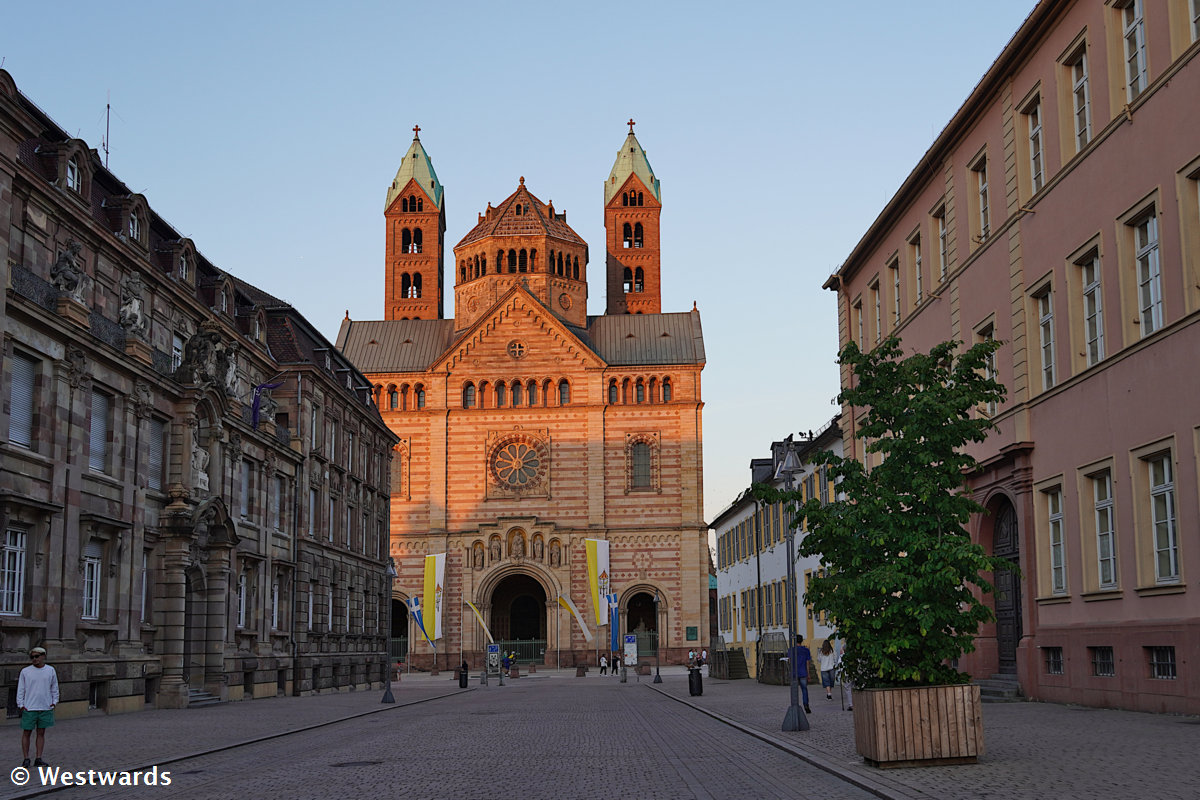
Our visit to Speyer Cathedral was almost accidental. We were in Mainz for the 60th birthday party of an old friend. But since the celebration fell on a bank holiday, trains back to Berlin were crowded and very expensive. So instead of rushing home, we decided to stay an extra day and explore the region.
That gave us the welcome opportunity to finally visit Speyer Cathedral. As one of Germany’s most famous Romanesque churches and also a UNESCO site, it had been on our travel wish list for years. And since Speyer is a relatively small town, spending a full day there seemed ideal, allowing plenty of time to explore the cathedral in depth.
In this blog post we take you on a tour through Speyer Cathedral. What makes it special? Is it worth a detour? We thoroughly enjoyed it, but should you go there? We hope this post helps you decide whether a visit to Speyer Cathedral should be on your own travel itinerary.
The historical importance of Speyer Cathedral
To fully appreciate a visit to Speyer Cathedral, it helps to understand why this church exists in the first place. Today the enormous cathedral dominates the old town. It is a UNESCO World Heritage site and a major tourist attraction in the Southwestern part of Germany. Yet around the year 1000 AD, Speyer was little more than a small village on the banks of the River Rhine.
Everything changed when the Salian Emperor Konrad II chose Speyer as the site for a grand new cathedral in the early 11th century. He wanted a church that would reflect the power and prestige of his dynasty, and he thought big. The project was so ambitious that Konrad himself did not live long enough to see his project completed. By the end of the 11th century, however, his successors could show off the largest church in the Holy Roman empire. Even today, Speyer Cathedral remains the world’s largest surviving Romanesque church, at 134 m in length.
Ups and downs of a cathedral
As you walk through the cathedral, you are not simply visiting a medieval church. For centuries, this was one of the most important places in the empire. Konrad himself and quite a few of his successors were buried in the cathedral’s crypt. Accordingly, the church was known as “Kaiserdom” (Emperors’ Cathedral). And in 1146 Speyer Cathedral became the floor of world politics when the influential monk St. Bernard of Clairvaux preached in the cathedral. It was then that he persuaded King Konrad III to take part in the Second Crusade.
The cathedral did not pass through the centuries unchanged. Wars, fires, and rebuilding projects left their marks on the structure. Reconstructions in the 18th and 19th century altered its appearance markedly. By contrast, during the 20th century, restoration work sought to recover much of its original Romanesque character.
A visit to Speyer Cathedral offers more than a glimpse into the Middle Ages. The building itself tells a story of imperial ambition and religious devotion, of destruction and renewal, spanning almost a thousand years.
A first glimpse of Speyer Cathedral
We arrive in Speyer rather late, and around 8 pm we venture out to find some food – with some apprehension. After all, the Pfalz region is known for meat-lovers’ delicacies such as sausages and the famous Saumagen. Saumagen is a pig’s stomach stuffed with meat and potatoes. It became famous because former German Chancellor Helmut Kohl often served it to visiting state guests. Helmut Kohl came from this area and loved the hearty cuisine …
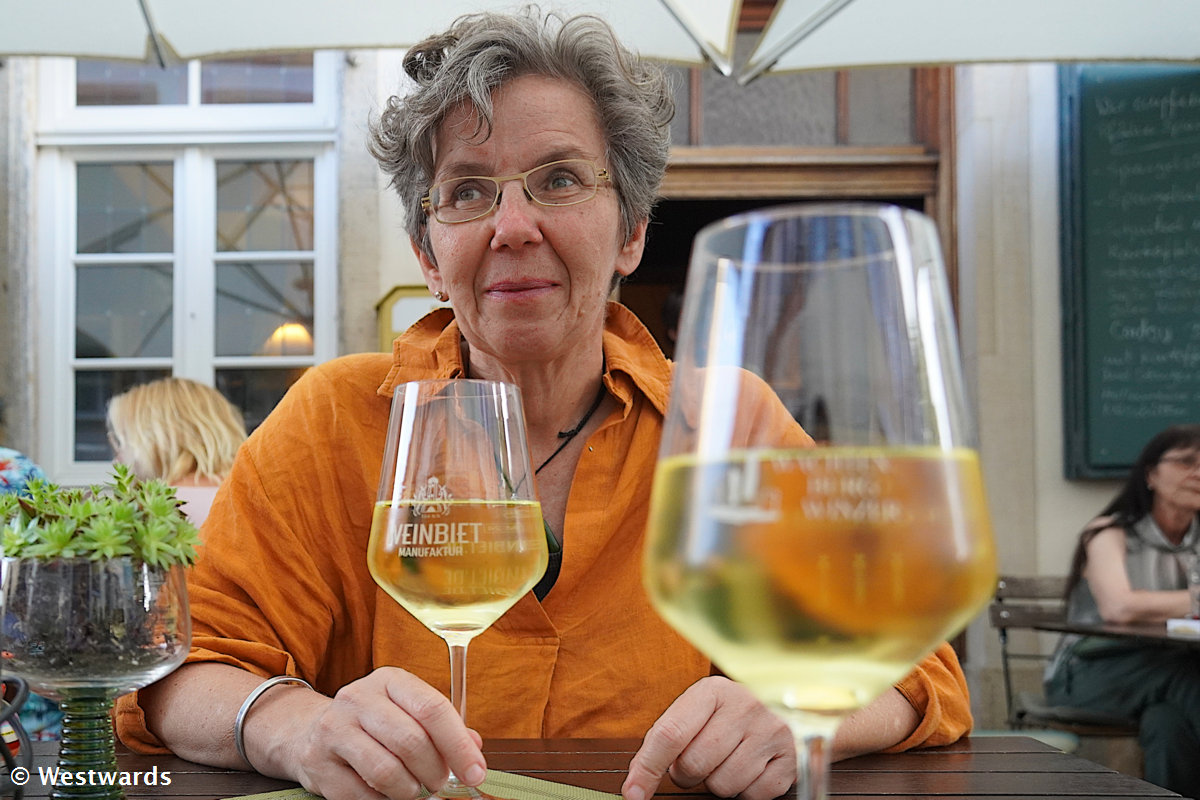
We had even spotted a vegan place that promised creative versions of these regional classics and were curious to try it – but unfortunately it is closed this evening. Instead, we end up in a regional wine bar called Rabennest (raven nest). The combination of local wine, cheese, and some salad feels exactly right.
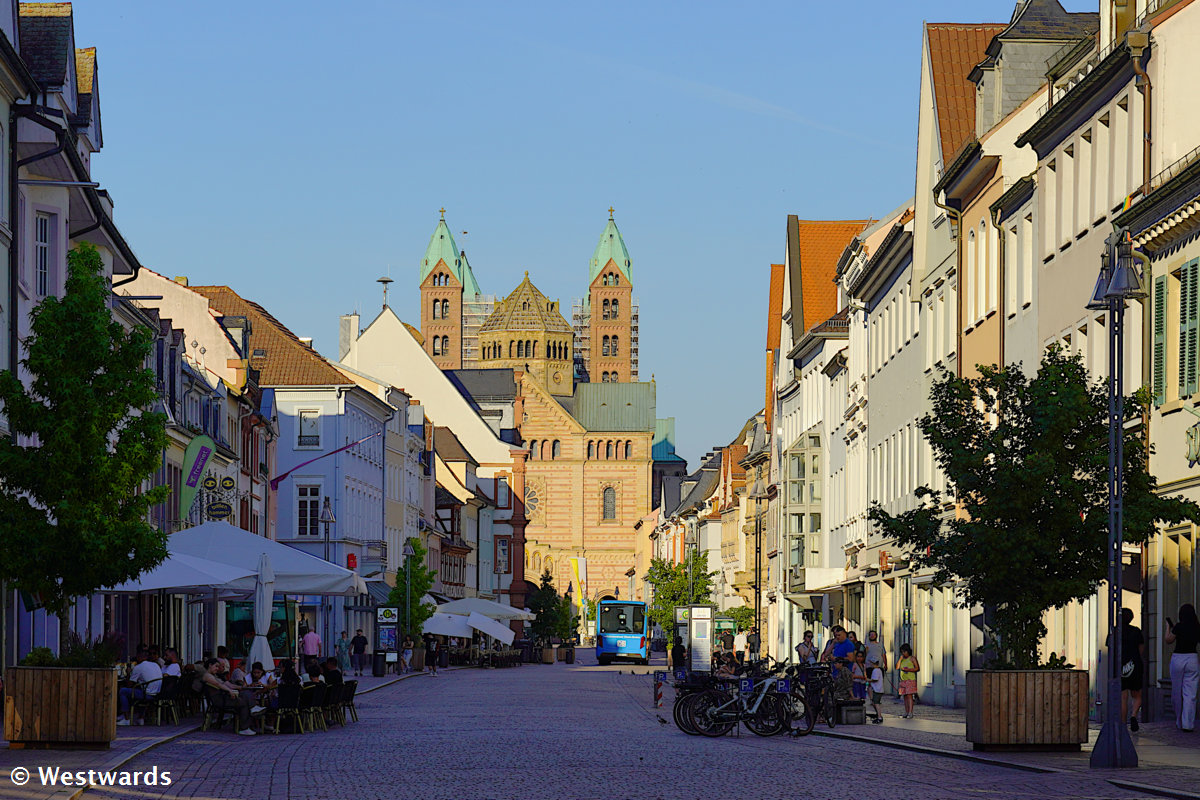
While walking through one of the old alleys afterwards, we get a good first view of Speyer Cathedral, softly lit by the evening light. Perfect for a few first photos!
A tour of Speyer Cathedral
Since we have basically set aside the whole day to visit Speyer Cathedral, we head there first thing in the morning. At the information desk next to the Crypta we get a stack of leaflets and an audio guide.
Back outside, we decide to start properly with the façade and commit to listening to every single item on the audio guide’s list. The staff at the reception desk had estimated about 1.5 hours for the whole tour. It sounded good at the time.
In the end, it turns into a much longer visit. Even though we skip some of the sections, we still spend more than three hours in and around the Speyer Cathedral! By the time we finally leave, we have climbed roughly 250 steps up and down and explored almost every corner of this huge church.
The façade of Speyer Cathedral
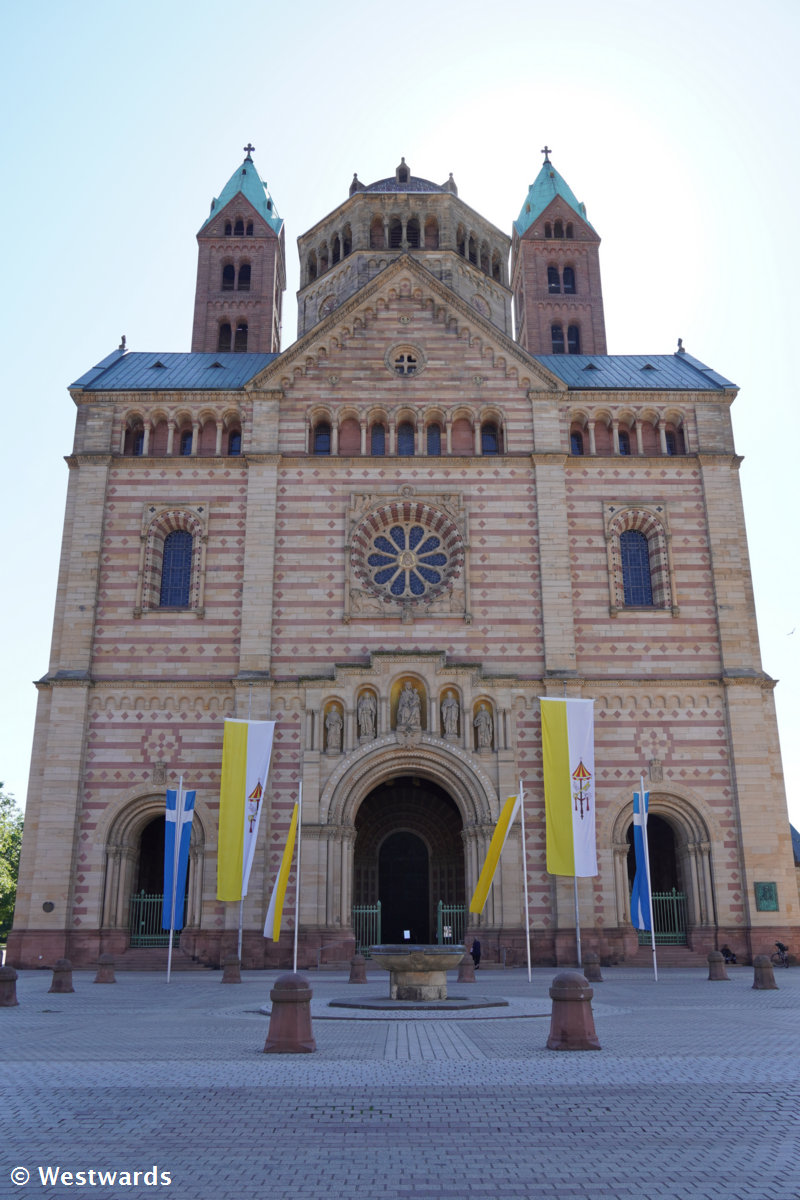
In front of the cathedral, we mix with several Rhine-cruise tour groups admiring the richly decorated façade.
The audio guide informs us that the façade used to be much simpler when the church was built in the 11th century. What we now see is largely 19th century Neo-Romanesque reconstructions. Then follows an explanation of the symbolism, delivered as if it had always been part of the plan: The round rosette window symbolises God, and the square around it the worldly sphere. And then there’s the three-fold structure symbolising the Holy Trinity, and seven arches for the seven days of creation. The audio guides on our ears, we wonder – did the 11th-century builders sit there quietly encoding their world-view into geometry, like in a medieval Dan Brown novel? Or did the 19th century just get really enthusiastic with meanings?
From storage room to Emperor’s Hall
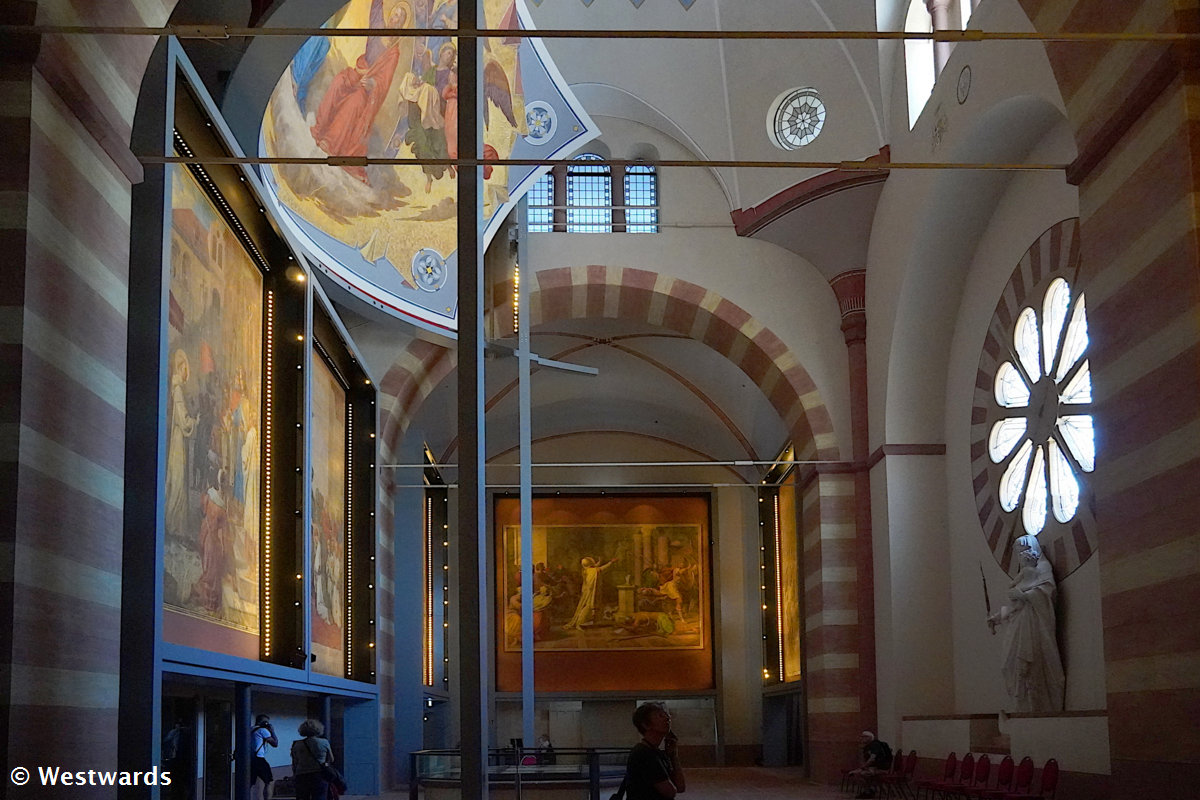
We follow the audio guide into the entrance hall with its statues of important kings and emperors. We decide to climb the church tower first. One story up, we reach a large room just above the entrance hall, with the rather illustrious name “Emperor’s Hall”. The name suggests grandeur, as if emperors once gathered here for important matters of state. In reality, it never functioned as an emperor’s pew or the like. In fact, it even served as a storage room for a while until the church officials decided to open the tower for visitors.
Frescoes in and out of fashion
Today, it is a display gallery for some of the huge frescoes that once adorned the church walls. The frescoes date back to the 19th century when King Ludwig I of Bavaria was in charge here, the father of the more famous Ludwig II. While Ludwig I was a great patron of the arts, Ludwig II is best remembered for building the fairy-tale Neuschwanstein Castle and inspiring a scenic hiking trail in Bavaria dedicated to his legacy. Ludwig I also commissioned frescoes in the fashionable Nazarene style at the Speyer Cathedral. At that time, it was considered refined and devout. But alas, the (somewhat kitschy) style went out of fashion in the 20th century, and off they took the frescoes. A few survived and are now shown here in the Emperor’s Hall.
Among them St. Bernard of Clairvaux preaching in favour of a new crusade. The audio guide now admits that perhaps, in retrospect, the crusades were not such a good idea, nor in line with Christian ideals of peacefulness. Still, it argues, St. Bernard acted laudably according to his convictions, even if we judge them differently today.
We are not entirely convinced by this balance of praise and regret. Outside the narrative, a sickly hornet stumbles along a row of chairs. And we wonder whether we should help it out or simply let it find its own way. In the end we just continue our ascent of the tower.
The view from Speyer Cathedral’s tower
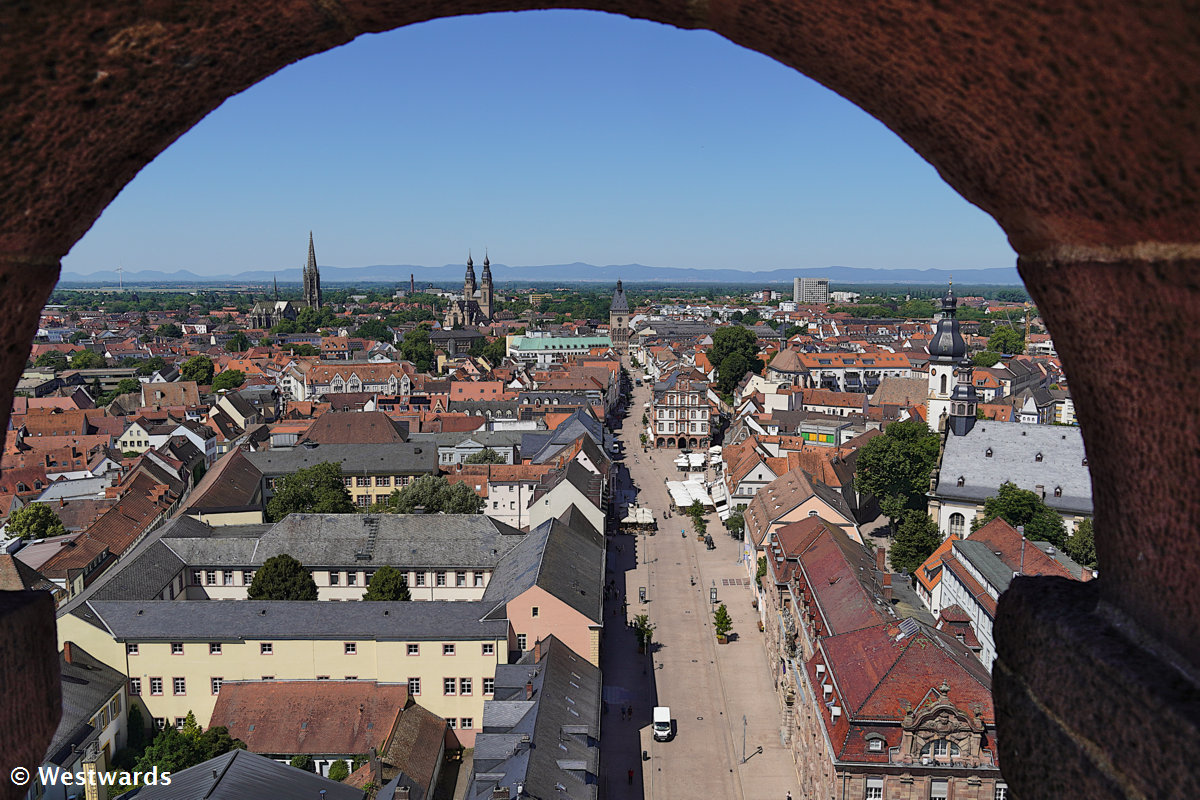
The route takes us now up the southwestern tower of the church. Spiral staircase, square staircase, concrete stairs, metal stairs, then spiral staircase again. At one point we see a part of the original wooden staircase in the opposite tower.
Eventually we reach the top and a beautiful view unfolds over the small town of Speyer. From here Speyer looks unexpectedly compact and orderly. The old town stretches out below us on one side, and on the other side, the River Rhine flows slowly.
To the South we notice a large airplane. It is part of the exhibition at the Technik Museum Speyer, where real aircraft, cars, steam engines, submarines, and other pieces of ambitious engineering sit outdoors and indoors alike.
A somewhat strange view: a full-size aircraft next to this small, historic town.
The interior of Speyer Cathedral
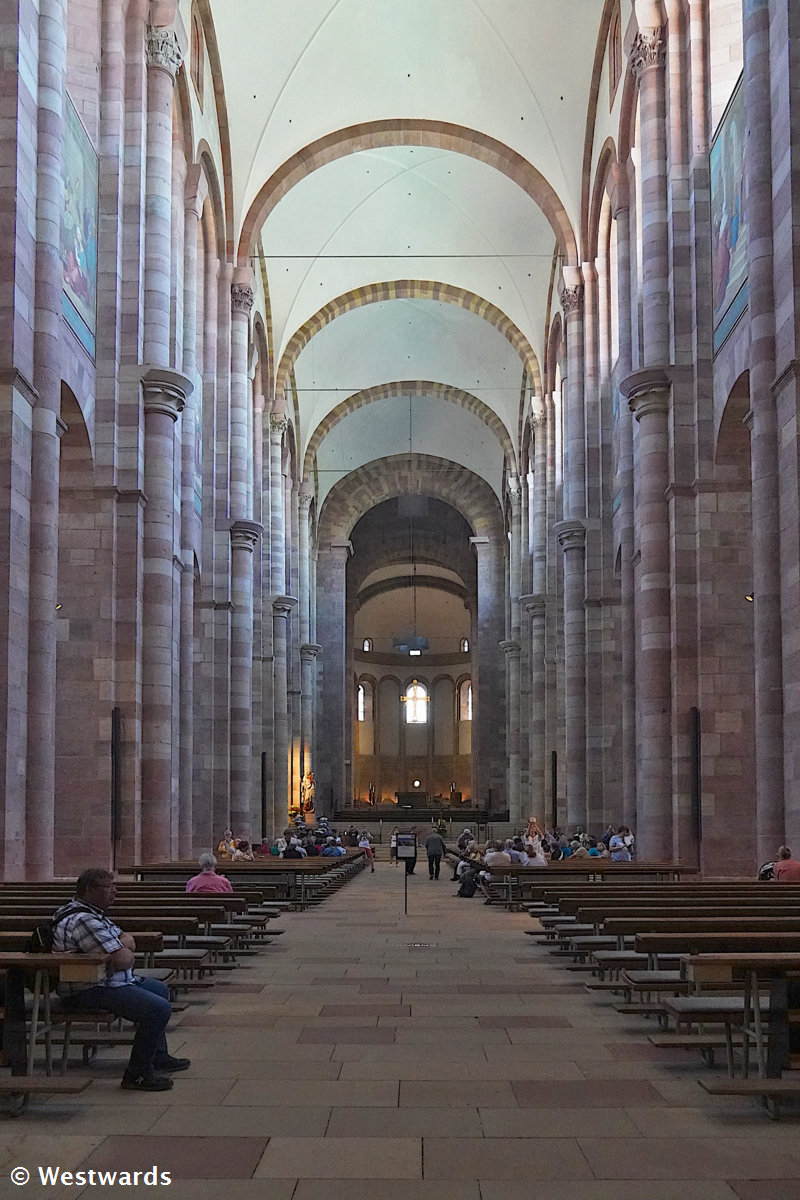
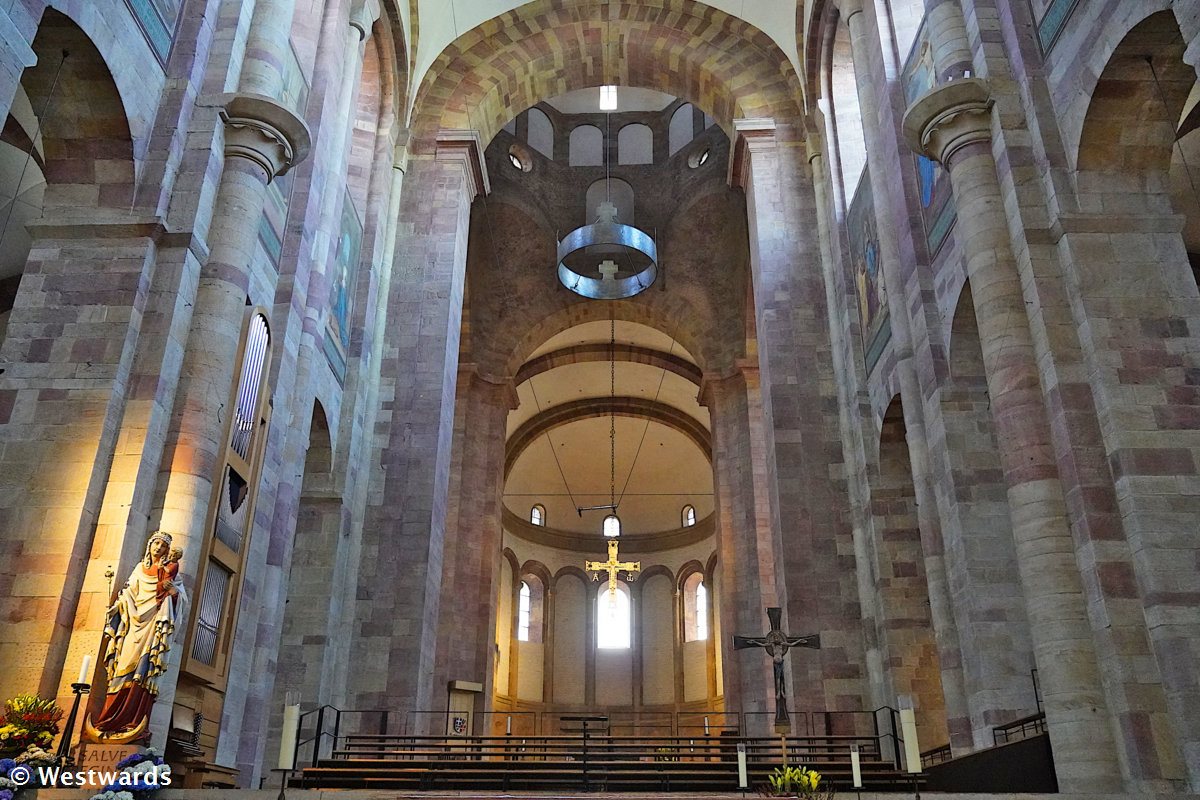
Back on the ground, we enter the main church room just as the huge organ begins playing. One of the cruise ship tour groups may have paid for the performance. The music provides a fitting background as we walk around the nave. We find the audio guide a bit underwhelming in this part of the church, but that is perhaps because we are familiar with the fittings of a catholic church anyway. Images of saints, confessional box, baptismal font, pulpit, transept …
Again, they explain the symbolism in the number of door arches: 6 inside, 6 outside – that’s 12 for the number of apostles. And the number of bays in the nave is 6, so that the crossing over the altar would be 7: like the seventh day of creation! Which makes the apse number 8. “What is the 8th day?” sounds like a zen koan (more on this here) to us, but they seem to take it for the day of Last Judgement.
Emperors in the crypt
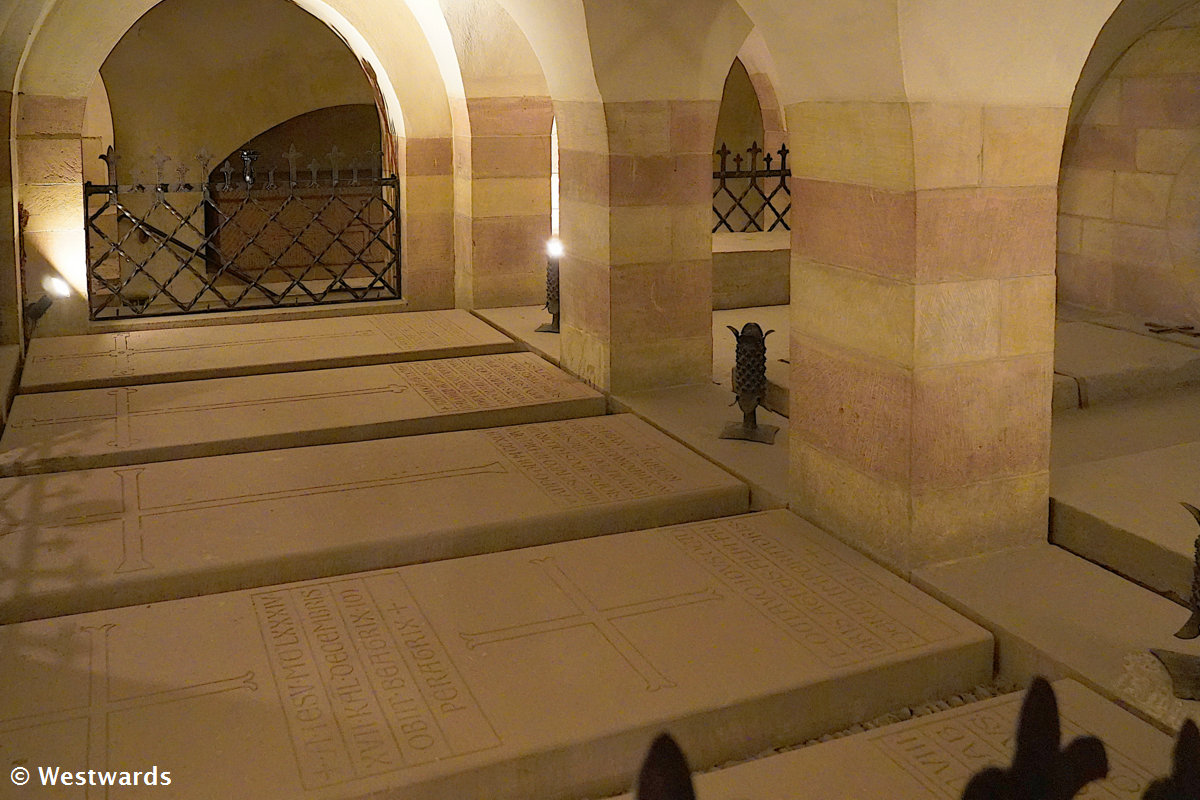
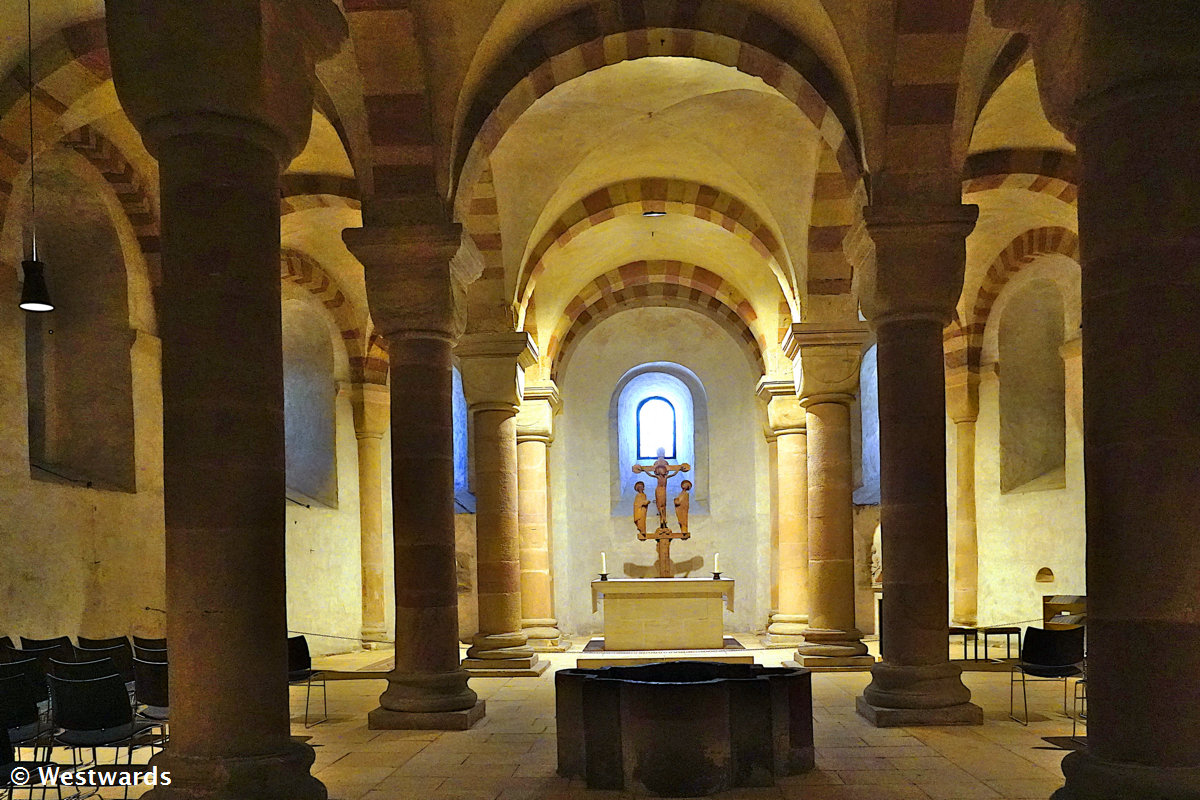
We take the cue to step down into the crypt. Below the nave and the altar are numerous stone coffins. They hold the remains of emperors such as Konrad II, Heinrich III and Heinrich IV. Some other tombs had been plundered in a regional war in the 17th century. And the whole crypt was rearranged around 1900.
While the audio guide asks visitors to preserve the solemn atmosphere and dignity of the tombs and not listen to the commentary while walking through the crypt, a tour leader is explaining the distribution of the dead emperors almost at shouting volume.
Back in the main nave, we hand back the audio guides and proceed to visit the second UNESCO site of Speyer, the Judenhof. This former Jewish quarter contains the remains of one of the most important medieval Jewish communities in Europe. The highlight is the well-preserved ritual bath (mikveh).
Should you visit Speyer cathedral?
If you are into history and visiting UNESCO sites as much as we are, a visit to Speyer cathedral is a must if you are in the area. Taking the audio guide definitely helps appreciating the church and its many layers of symbolism and history. Speyer itself is explored fairly quickly, and there are a few more sights worth seeing. These include the Historical Museum of the Palatinate and the medieval Jewish quarter. And as a counterweight to the staunchly catholic cathedral there’s a church commemorating the beginnings of Protestantism in 1529 in Speyer: the Protestationskirche.
So: would you like to visit Speyer cathedral?
If you enjoyed reading, we’d love to have you along for the journey. Subscribe for free email notifications whenever we publish a new post. This article was not sponsored in any way – we paid all travel, accommodation, admission, and other expenses ourselves. Our blog is completely ad-free, and you’ll never receive spam, just our latest stories delivered straight to your inbox.
Also have a look at our other blog posts about UNESCO churches we visited in Germany
The Pilgrimage church of Wies – A Baroque stuccoed dream coming true
Aachen Cathedral – Splendour of Charlemagne
Interested? Use this image to pin the post to Pinterest:

Liebe Westwards-Damen, vielen Dank für Ihre unterhaltsamen und hilfreichen Reiseberichte. Der Beitrag über Speyer hat mich an unseren Besuch dort erinnert (als Flexitarier haben wir tatsächlich Saumagen probiert, und er hat besser geschmeckt, als befürchtet). Da wir Ihr Interesse an historischen Bauwerken teilen, möchte ich einen Tipp geben – falls Sie nocht nicht dort waren und es Sie mal in den äußersten Südwesten Deutschlands verschlägt: https://www.tripadvisor.de/Attraction_Review-g1079302-d3520107-Reviews-Abbatiale_Saint_Pierre_et_Saint_Paul-Ottmarsheim_Haut_Rhin_Grand_Est.html. Die Abteikirche in Otmarsheim ist zwar nicht UNESCO-gelistet, aber gehört zur Route Romane d’Alsace (https://de.wikipedia.org/wiki/Romanische_Stra%C3%9Fe_im_Elsass), die viele Überraschungen für Romanik-Liebhaber bereit hält. Man sollte keinen ganzen Tag für Otmarsheim einplanen, aber einen Zwischenstopp ist sie unbedingt wert, und es gibt benachbart sogar ein nettes kleines Bistro. Viele Grüße aus Südbaden und weiterhin schöne Reisen
Ada Kohlsmann (Ms)
Danke, das klingt ja wirklich nach einem guten Tipp! Das Elsass fehlt uns sowieso noch, und Ottmarsheim wäre ja auch beim Rhein-Radweg an der Route.
Viele schöne Reisen noch!
Westwards